
Even Harmonics: Can They Be Ignored?
Myth or fact — an analysis based on laboratory simulations
The belief that even-order harmonics can be ignored when sizing capacitors and filters is a myth. Simulations based on field measurements show resonance with the 4th harmonic and equipment failure when the full spectrum is not considered.
Myth or fact?
Laboratory simulations were run, using field measurements, with a 50 kVAr / 380 V capacitor — rated current 76 A, limit with harmonics 98 A. The results showed that detuning reactors were required.
Table 1 — Capacitor without reactor (390 V)
In the values below, even harmonics were ignored. Even so, the capacitor's maximum limits were exceeded. The tests assumed the worst case, neglecting the source impedance.
| Quantity | Value |
|---|---|
| Fundamental current | 77.72 A |
| Largest harmonic currents | 7th: 29.68 A · 11th: 29.15 A · 13th: 28.55 A |
| Total current (even harmonics ignored) | 99.27 A |
| Capacitor limit | 98 A |

Table 2 — With reactor (L+Lm = 0.481 mH)
Ignoring even harmonics, the simulation with a reactor suggested the problem was solved: the current dropped from 99 A to 81 A (limit 98 A). However, the impedance plot showed resonance with the 4th harmonic.
| Quantity | Value |
|---|---|
| Reactor | L+Lm = 0.481 mH, 106 A |
| Total current (even harmonics ignored) | 81.82 A |
| Capacitor limit | 98 A |
| Minimum impedance of the assembly | At the 4th harmonic (resonance) |
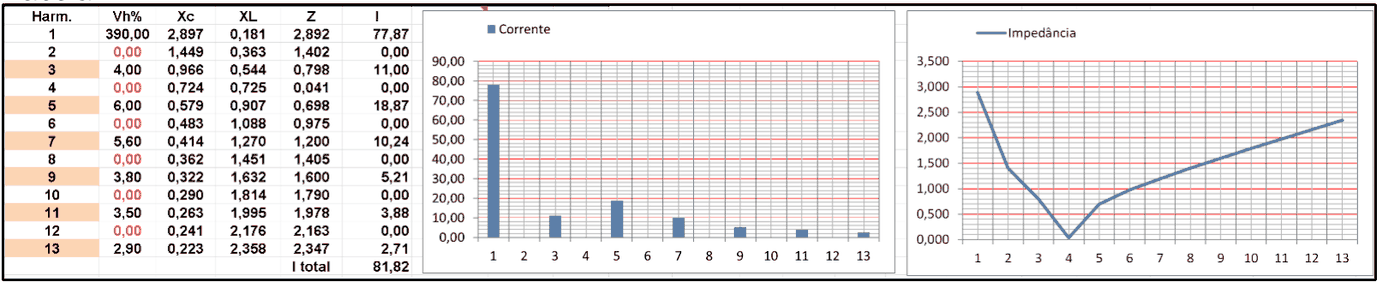
Table 3 — Including even harmonics
| Scenario | Total current | Limit | Result |
|---|---|---|---|
| Without even harmonics | 81.82 A | 98 A | Apparently within the limit |
| With even harmonics | 156.71 A | 98 A | Capacitor and reactor failure |
| 4th harmonic alone | 133.55 A | — | Resonance with the reactor |
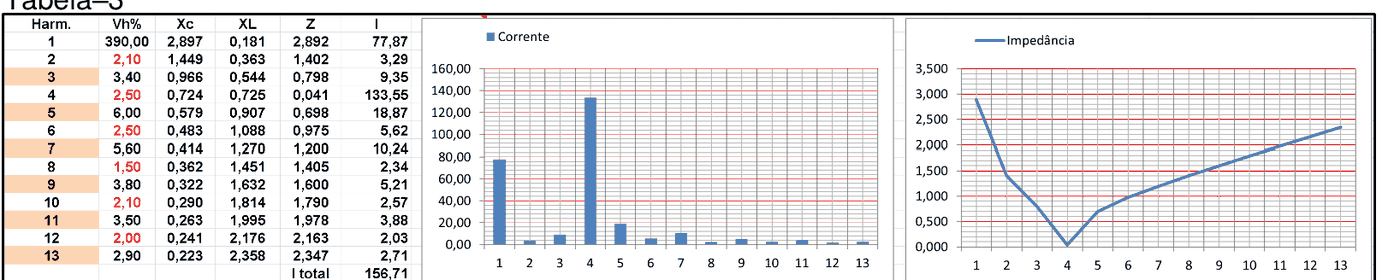
Table 4 — Solution: 16% detuning factor (L+Lm = 1.072 mH)
By changing the reactor's detuning factor to 16%, the current settled at 80 A, with no risk of resonance with any harmonic in the spectrum.
| Quantity | L+Lm = 0.481 mH | L+Lm = 1.072 mH (16% detuning) |
|---|---|---|
| Total current, with even harmonics | 156.71 A | 79.85 A |
| Current at the 4th harmonic | 133.55 A | 3.79 A |
| Resonance with the 4th harmonic | Yes | No |

Conclusions
- Advantage (16% detuning): detuned for the whole spectrum — even and odd harmonics
- Drawback: reactor size and cost increase by almost 100%
- Minimum capacitor dielectric rating must be > 440 V on 380 V networks
- Measurements of the electrical system must run for seven consecutive days, including a weekend
- Measurements must cover even harmonics, odd harmonics and interharmonics
Correct sizing
Correct filter sizing requires measuring power quality and power flow. Ask for Technical Bulletin BT 5.2: engenharia@dicelrs.com.br
“A clever person solves a problem; a wise person avoids it.”
— Albert Einstein